%20-%20http://www.bohemiancoding.com/sketch%20--%3e%3ctitle%3eLogo%3c/title%3e%3cdesc%3eCreated%20with%20Sketch.%3c/desc%3e%3cg%20id='Page-1'%20stroke='none'%20stroke-width='1'%20fill='none'%20fill-rule='evenodd'%3e%3cg%20id='logo-gap'%20transform='translate(-21.000000,%20-21.000000)'%3e%3cg%20id='Verysite_2018_Logo_gap'%3e%3cg%20id='Logo'%20transform='translate(20.895000,%2021.072000)'%3e%3cpath%20d='M59.178,0.456%20C91.6442925,0.457642562%20117.970749,26.7617206%20118,59.228%20C118,91.7142174%2091.6647174,118.0495%2059.1785,118.0495%20C26.6922826,118.0495%200.357,91.7142174%200.357,59.228%20C0.386250972,26.762111%2026.7120979,0.458194449%2059.178,0.456%20Z'%20id='Path_1430'%20fill='%23fff'%3e%3c/path%3e%3cpolygon%20id='Path_11112'%20stroke='%23fff'%20stroke-width='3'%20fill='%23293338'%20stroke-linecap='round'%20stroke-linejoin='round'%20points='71.085%2089.532%2046.159%2089.532%2019.526%2045.005%2034.226%2027.942'%3e%3c/polygon%3e%3cpolygon%20id='Path_11113'%20stroke='%23fff'%20stroke-width='3'%20fill='%23FDCB00'%20stroke-linecap='round'%20stroke-linejoin='round'%20points='46.176%2089.532%2071.096%2089.532%2097.743%2045.005%2083.031%2027.941'%3e%3c/polygon%3e%3c/g%3e%3c/g%3e%3c/g%3e%3c/g%3e%3c/svg%3e "VeryCreatives")
AI for SaaS Products
AI Features for Your SaaS, Built the Right Way
80% of developers now use AI tools, but most SaaS AI features fail within months. Not because AI doesn't work. Because they're added to the wrong problem, in the wrong place, by teams without a plan for what happens when the AI gets it wrong. We help non-technical founders add AI that users actually adopt.
 Our services are available worldwide,
including Germany



'%3e%3cpath%20fill-rule='evenodd'%20clip-rule='evenodd'%20d='M0.0078125%208.7688H32.613L16.341%200.0966187L0.0078125%208.7688Z'%20fill='%23293338'/%3e%3cpath%20fill-rule='evenodd'%20clip-rule='evenodd'%20d='M32.695%2019.3069H0.0625L16.341%2028L32.695%2019.3069Z'%20fill='%23293338'/%3e%3cpath%20fill-rule='evenodd'%20clip-rule='evenodd'%20d='M15.5127%209.87103L17.4863%2014.5992L19.2611%2010.2315H20.6122L17.528%2017.9738L15.4914%2013.1804L13.3941%2017.9738L10.2891%2010.2534H11.6601L13.4354%2014.5992L15.5127%209.87103Z'%20fill='%23293338'/%3e%3cpath%20fill-rule='evenodd'%20clip-rule='evenodd'%20d='M9.40258%2015.003H8.12645L8.75135%2013.3888L9.40258%2014.9602C9.40258%2014.9602%209.40258%2014.9601%209.40258%2015.003ZM8.75135%209.87103L5.6875%2017.6703H7.01726L7.60587%2016.3152H9.92316L10.4845%2017.6703H11.842L8.75135%209.87103Z'%20fill='%23293338'/%3e%3cpath%20fill-rule='evenodd'%20clip-rule='evenodd'%20d='M22.8566%2015.0249H21.5884L22.1924%2013.4102H22.2123V13.4321L22.8566%2015.0029C22.8566%2015.0029%2022.8566%2015.0029%2022.8566%2015.0249ZM22.2123%209.89294L19.1484%2017.6922H20.4787L21.0609%2016.3371H23.3985L23.9469%2017.6922H25.3174L22.2123%209.89294Z'%20fill='%23293338'/%3e%3cpath%20fill-rule='evenodd'%20clip-rule='evenodd'%20d='M2.16213%2014.5778V16.4239H3.27333C3.84209%2016.4239%204.22506%2015.9548%204.22506%2015.4277C4.22506%2014.9163%203.84209%2014.5778%203.27333%2014.5778H2.16213ZM2.16213%2011.4784V13.2222H3.27333C3.75963%2013.2222%203.97868%2012.7975%203.97868%2012.2647C3.97868%2011.9476%203.69754%2011.5004%203.27333%2011.5004L2.16213%2011.4784ZM0.8125%2010.2749H2.62905C2.84762%2010.2749%203.63593%2010.2315%204.01892%2010.3752C4.82859%2010.6573%205.21256%2011.3557%205.27465%2011.9475C5.37052%2012.8628%205.17135%2013.137%204.74714%2013.7273C5.41177%2014.3474%205.59656%2014.6441%205.59656%2015.552C5.61643%2016.2066%205.2538%2017.0351%204.44512%2017.4624C4.06164%2017.6703%203.86195%2017.6923%202.95093%2017.6923H0.8125V10.2749Z'%20fill='%23293338'/%3e%3cpath%20fill-rule='evenodd'%20clip-rule='evenodd'%20d='M30.1125%2016.0634C30.3932%2015.7881%2030.3932%2015.8111%2030.6947%2015.2333H29.283V13.9227H32.2912V13.9869C32.2912%2016.3585%2030.352%2017.9085%2028.5419%2017.8651C27.1848%2017.8223%2026.2186%2017.1218%2025.6568%2016.2285C25.1084%2015.4062%2024.9097%2014.4278%2024.9504%2013.7926C25.0533%2012.3289%2025.7184%2011.5651%2026.3214%2011.0177C27.0899%2010.3187%2028.1991%2010.1024%2028.8444%2010.1239C29.4057%2010.1458%2030.0713%2010.3751%2030.6535%2010.758C31.0374%2010.9952%2031.4617%2011.4784%2031.7637%2011.9475L30.6535%2012.6684C30.1736%2012.0128%2029.7285%2011.4204%2028.5766%2011.4784C27.7332%2011.5437%2027.1505%2011.9041%2026.7665%2012.3936C26.3835%2012.8627%2026.1977%2013.5403%2026.2802%2014.3474C26.3835%2015.1263%2026.6642%2015.4496%2026.9662%2015.8111C27.4113%2016.38%2027.9934%2016.5106%2028.741%2016.5106C29.3023%2016.5106%2029.7479%2016.2932%2030.1125%2016.0634Z'%20fill='%23293338'/%3e%3c/g%3e%3cdefs%3e%3cclipPath%20id='clip0_20410_102976'%3e%3crect%20width='33'%20height='28'%20fill='white'/%3e%3c/clipPath%3e%3c/defs%3e%3c/svg%3e)




'%3e%3cmask%20id='mask0_20411_103350'%20style='mask-type:luminance'%20maskUnits='userSpaceOnUse'%20x='0'%20y='0'%20width='119'%20height='18'%3e%3cpath%20d='M119%200H0V18H119V0Z'%20fill='white'/%3e%3c/mask%3e%3cg%20mask='url(%23mask0_20411_103350)'%3e%3cpath%20d='M77.6603%20-0.00128174L77.1666%202.18778H71.2072L70.6122%204.92287H75.8216L75.3797%206.94616H70.1856L69.1142%2011.8402H66.457L69.011%20-0.00128174H77.6603Z'%20fill='%23293338'/%3e%3cpath%20d='M81.3521%20-0.00128174L79.2761%209.65108H85.1497L84.6767%2011.8402H76.1289L78.6571%20-0.00128174H81.3521Z'%20fill='%23293338'/%3e%3cpath%20d='M97.546%20-0.00128174L97.0868%202.18778H90.4809L89.9357%204.72525H96.0481L95.606%206.74851H89.4936L88.8624%209.65108H95.57L95.0936%2011.8402H85.7305L88.2674%20-0.00128174H97.546Z'%20fill='%23293338'/%3e%3cpath%20d='M107.896%20-0.00128174L107.437%202.18778H100.832L100.287%204.72525H106.4L105.958%206.74851H99.8451L99.2139%209.65108H105.922L105.445%2011.8402H96.082L98.6189%20-0.00128174H107.896Z'%20fill='%23293338'/%3e%3cpath%20d='M108.379%202.18946L108.855%20-0.00128174H119.003L118.526%202.18778H114.882L112.806%2011.8402H110.114L112.199%202.18946H108.379Z'%20fill='%23293338'/%3e%3cpath%20d='M61.2345%207.09016C61.8135%206.75888%2062.2934%206.28534%2062.6257%205.71691C62.958%205.14846%2063.131%204.50503%2063.1281%203.85095C63.1281%201.12926%2060.6291%200.192994%2059.3081%200.0791016H59.2722H51.4844V11.7933H53.2249V1.6401H59.1862C59.5215%201.67694%2061.5061%201.97507%2061.5061%203.8409C61.5061%205.45214%2060.0287%205.93785%2059.8604%205.98811L58.8869%206.27617L59.3958%207.13707L62.1631%2011.7849H64.0292C62.9663%2010.0045%2061.6713%207.82545%2061.2345%207.09519'%20fill='%23293338'/%3e%3cpath%20d='M39.6109%200.0641479H28.8516V1.63687H33.361V11.7699H35.0998V1.63687H39.6109V0.0641479Z'%20fill='%23293338'/%3e%3cpath%20d='M23.2709%200.065918H21.4048L16.4654%208.39179L11.5362%200.065918H9.67188L16.4637%2011.5406L23.2709%200.065918Z'%20fill='%23293338'/%3e%3cpath%20d='M36.5234%2011.7797H38.3895L39.5368%209.84689H47.1042L48.2497%2011.7797H50.1105L43.3239%200.305054L36.5234%2011.7797ZM40.3985%208.39474L43.3222%203.45385L46.2459%208.39474H40.3985Z'%20fill='%23293338'/%3e%3cpath%20d='M18.6992%2011.7797H20.5636L21.7107%209.84689H29.2886L30.4322%2011.7797H32.2983L25.5048%200.305054L18.6992%2011.7797ZM22.5724%208.39474L25.4961%203.45385L28.42%208.39474H22.5724Z'%20fill='%23293338'/%3e%3cpath%20d='M0%2012.5384H1.86435L3.09749%2010.4515H11.4114L15.3069%2017.017H17.1747L7.24239%200.288269L0%2012.5384ZM10.5514%209.00772H3.95227L7.24412%203.43705L10.5514%209.00772Z'%20fill='%23293338'/%3e%3cpath%20d='M112.541%2013.2302L112.23%2014.9101L18.6992%2014.0676L112.541%2013.2302Z'%20fill='%23293338'/%3e%3cpath%20d='M112.132%2015.4494L111.903%2016.6905L34.9336%2016.0976L112.132%2015.4494Z'%20fill='%23293338'/%3e%3cpath%20d='M111.801%2017.2147L111.656%2018.0002L56.457%2017.605L111.801%2017.2147Z'%20fill='%23293338'/%3e%3c/g%3e%3c/g%3e%3cdefs%3e%3cclipPath%20id='clip0_20411_103350'%3e%3crect%20width='119'%20height='18'%20fill='white'/%3e%3c/clipPath%3e%3c/defs%3e%3c/svg%3e)

80%
of developers use AI tools in their workflows (Stack Overflow, 2025)
45%
of AI-generated code contains security vulnerabilities without proper review (Veracode, 2025)
40%
of new enterprise software will use AI coding techniques by 2028 (Gartner, 2025)
Why most SaaS
AI features fail
The problem is almost never the AI itself. The models are capable. The APIs are reliable. The problem is the decision made before a line of code was written: what problem should the AI solve, and how should it be built into the product?
Key takeaways
- The question isn't whether to use AI. 80% of developers already do (Stack Overflow, 2025). The question is where in your product it creates genuine value for users.
- AI features that fail almost always share the same root cause: they were designed as a feature, not as a constraint that shapes the whole product architecture.
- 45% of AI-generated code contains security vulnerabilities without proper review (Veracode, 2025). The risk is architectural, not cosmetic.
- Getting the AI use case wrong at discovery costs hours. Getting it wrong in production costs months of user churn and a rebuild.

- Solving a problem users don't haveThe most common failure: an AI feature is added because it is technically impressive, not because users were struggling without it. An AI summariser in a product where users read everything. An AI assistant in a workflow that takes 30 seconds. The feature gets built, shipped, and ignored. Usage data confirms what a single user interview would have caught in week one.
- Retrofitting AI onto a product not designed for itAI features require structured data pipelines. If your product stores user data in a format that was never intended for AI processing, adding intelligence later means rebuilding the data layer, not adding a new API call. This is the most expensive AI mistake, and it's made in the product strategy phase, not the development phase.
- Single-vendor dependency with no abstraction layerTeams that integrate directly against one LLM provider without an abstraction layer find themselves locked in when the provider changes pricing, deprecates a model, or experiences downtime. Switching costs grow with every feature built on top. The abstraction layer is a 2-day architectural decision that pays for itself the first time a model is deprecated.
- No way to know if the AI is workingStandard SaaS features either work or they don't. AI features exist on a spectrum of quality. A recommendation engine that produces results 70% of users ignore is technically working. Without an evaluation framework built in from day one, you have no signal for when the AI is degrading, and no baseline to measure improvements against.
What AI capabilities can we build for your SaaS?
The right AI capability depends on your product's core value proposition, your users' primary workflow, and the data your product already has. We help you identify which of these categories belongs in your product before we write a line of code.
LLM-Powered Features
Chat interfaces, document analysis, content generation, and natural language workflows built on models like GPT-4, Claude, or Gemini. Best when your users work with text-heavy content or complex information.
Intelligent Automation
Workflow automation that makes decisions based on data patterns rather than fixed rules. Categorisation, routing, prioritisation, and anomaly detection. Best when your product handles high-volume repetitive decisions.
AI-Assisted Workflows
Suggestions, recommendations, and smart defaults embedded into existing user journeys. The AI reduces friction without replacing user control. Best for products where users make frequent similar decisions.
Data Intelligence
Analytics that surfaces insights users would otherwise miss: trends, anomalies, correlations, and predictions. Best when your product accumulates user data over time and users currently spend significant effort analysing it.
How we approach AI product development
AI development follows the same four-phase process as our standard SaaS builds, with two additional steps that most agencies skip: use case validation before scoping, and evaluation framework design before shipping.
1
AI Use Case Validation
Before any architecture decisions, we validate whether the proposed AI feature solves a problem users actually have and whether the expected value justifies the added complexity. Most AI feature briefs change significantly at this stage, and that is the point. A 2-day validation sprint is the cheapest way to avoid a 3-month rebuild.
2
Architecture Design
We design the data pipeline, API abstraction layer, and evaluation framework before development starts. This includes choosing between LLM providers, deciding on retrieval-augmented generation (RAG) vs fine-tuning, and structuring the data model to support AI processing without a future rebuild. These decisions are 10x cheaper to make correctly upfront.
3
Build and Integration
We implement the AI feature as part of the product, not as a bolt-on module. The UI, the data flows, and the error handling are all designed together. We test against adversarial inputs and edge cases that production users will find immediately, even if QA doesn't.
4
Evaluation Framework
We build the measurement layer alongside the feature. You need to know your AI feature's baseline accuracy, where it degrades, and how to detect when a model update changes its behaviour. Without this, you're flying blind. We deliver a concrete evaluation framework before the feature goes live.
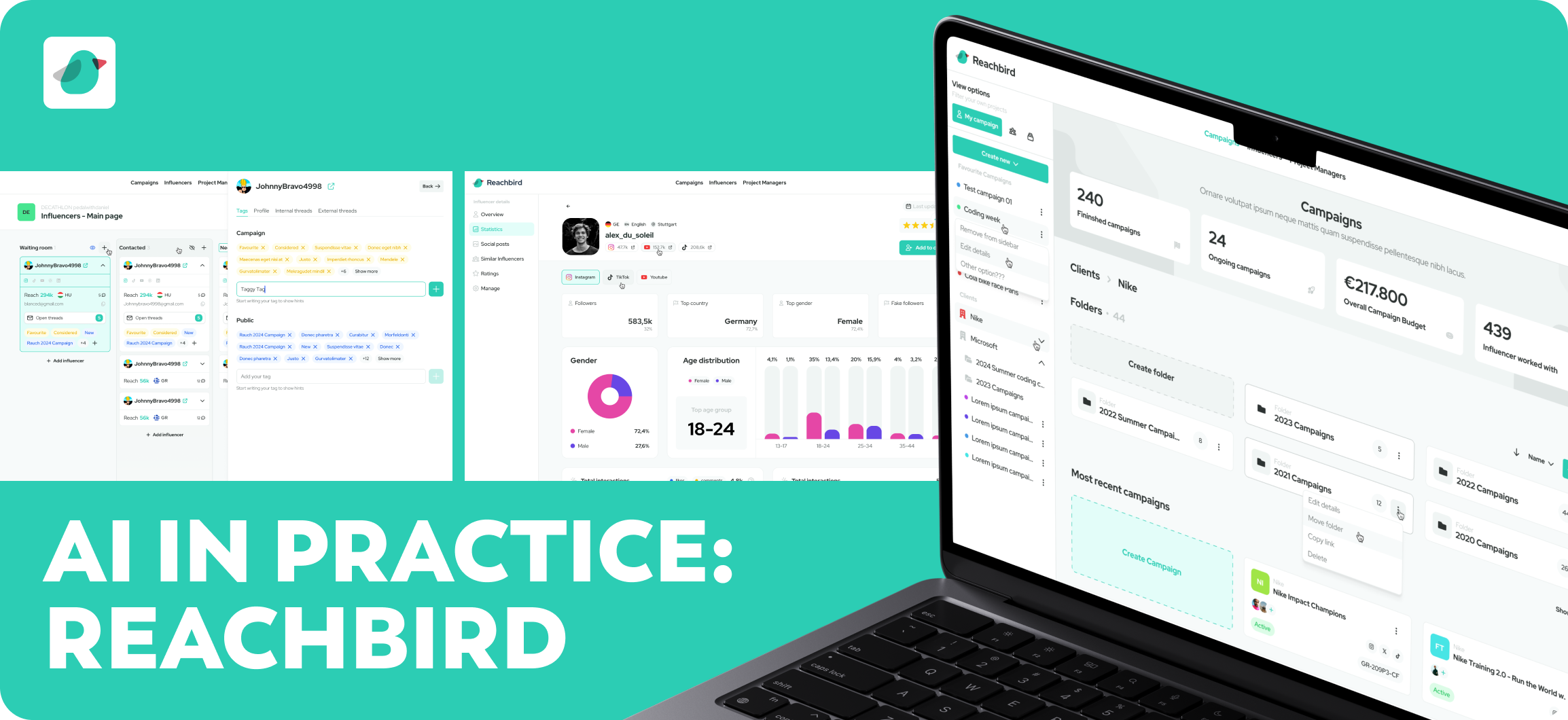
Reachbird is an influencer marketing platform that needed AI to power creator matching and campaign analytics. The challenge was building AI capabilities that delivered real value to non-technical marketing teams, not just impressive demos.
AI-Powered Creator Matching
We built an intelligent matching layer that analyses creator profiles, audience data, and past campaign performance to surface the most relevant creators for each brief. The algorithm improves with every campaign cycle.
Smart Campaign Analytics
Instead of raw data tables, the platform surfaces insights: which creators are over- or under-performing against benchmarks, which content formats are trending for specific audiences, and which campaigns have the highest predicted ROI.
Data Pipeline Architecture
The AI capabilities required a structured data pipeline that could process creator and campaign data at scale. We designed this as a first-class part of the product architecture, not as an afterthought.
“We were unsure on the specifics of how to achieve this, but VeryCreatives impressed us with their expertise and design direction. They understood our brief and helped us shape the solution.”

PHILIP MARTIN
Ceo & Co-Founder of Reachbird
Is this the right service for you?
We work with SaaS founders who want to add AI that users will actually use. We're honest about when AI is the right tool and when it isn't.
Good fit
You have a SaaS product or MVP and want to add a specific, validated AI capability
You're building from scratch and want AI architecture designed in from day one
You've added an AI feature and it isn't being adopted, and you want to understand why
You want an honest technical opinion on what AI can and can't do for your specific product
You're a non-technical founder who needs a team that can explain architectural trade-offs in plain English
Not the right fit
You want to "add AI everywhere" without a specific use case or problem to solve
You want AI as a marketing claim without the product functionality to back it up
You need enterprise ML research infrastructure or custom model training at scale
You want someone to implement AI without questioning whether the use case is right
Your primary concern is using the cheapest possible LLM without regard for accuracy or reliability
Frequently Asked Questions About AI for SaaS
Read our thinking on AI for SaaS products
These posts cover the decisions every non-technical founder faces when adding AI to a product.
Why VeryCreatives?
Ready to add AI the right way?
Book a free 30-minute call.
We'll tell you honestly whether AI belongs in your product right now, which use case has the most leverage, and what it would cost to build.
No commitment. No pitch deck. Just an honest
conversation about your product.
Contact Us
We work with about 12 founders per year. If you're a non-technical founder with a SaaS idea and a defined budget, the next step is a 30-minute free discovery call. We'll talk through your idea, your stage, and whether we're the right partner for what you're trying to build. If we're not, we'll tell you who is.
What happens next?
We'll get back to you within 48 hours to schedule a free online consultation with our founders, Máté and Ferenc. They'll discuss your initiative and give you honest, expert feedback on what it will take to build - whether you work with us or not.
Your data is safe
We'll only use what you share here to prepare for the conversation. No lists, no spam, no passing your details to anyone else.
What time zone are you in?
We're based in Budapest (GMT+2), working daily with teams across the EU, UK, US, and UAE. Overlap has never been the hard part.
Would you rather write an email?
Write to hello@verycreatives.com - we reply by the next working day at the latest.







%20--%3e%3csvg%20version='1.1'%20id='Ebene_1'%20xmlns='http://www.w3.org/2000/svg'%20xmlns:xlink='http://www.w3.org/1999/xlink'%20x='0px'%20y='0px'%20viewBox='0%200%202927.69%20366.04'%20style='enable-background:new%200%200%202927.69%20366.04;'%20xml:space='preserve'%3e%3cstyle%20type='text/css'%3e%20.st0{fill:url(%23SVGID_1_);}%20%3c/style%3e%3clinearGradient%20id='SVGID_1_'%20gradientUnits='userSpaceOnUse'%20x1='25.2367'%20y1='183.1596'%20x2='2902.4714'%20y2='183.1596'%3e%3cstop%20offset='0'%20style='stop-color:%232D363C'/%3e%3cstop%20offset='1'%20style='stop-color:%232D363C'/%3e%3c/linearGradient%3e%3cpath%20class='st0'%20d='M786.72,43.23L667.1,311.61h63.64l23.77-57.51h124.61l23.77,57.51c3.24,7.64,14.41,16.07,36.81,16.07%20s28.37-16.07,28.37-16.07l-120-268.38H786.72z%20M774.45,206.95l42.56-102.75l42.56,102.75H774.45z%20M433.97,199.66h124.6v-48.31%20h-124.6V93.07h141.09V43.23c0,0-151.25,0-163.49,0s-21.72-0.02-30.5,8.77c-8.79,8.79-8.83,17.89-8.83,30.42s0,229.2,0,229.2h207.81%20v-49.84H433.97V199.66z%20M257.97,140.62c0-60.19-44.86-97.39-116.56-97.39H25.24v268.38h62.11v-74.77h54.06h3.07l51.76,74.77%20c17.22,22.3,61.41,18.5,66.71,0l-60.19-86.27C237.64,210.4,257.97,180.87,257.97,140.62z%20M137.96,187.39H87.35V93.84h50.61%20c37.96,0,57.13,17.25,57.13,46.78C195.08,169.75,175.92,187.39,137.96,187.39z%20M1165.16,91.54c26.84,0,49.46,10.74,67.48,31.44%20l11.04-10.19l28.84-26.62c-25.3-30.68-64.03-47.54-110.42-47.54c-83.58,0-145.69,57.89-145.69,138.79%20c0,80.9,62.11,138.79,145.31,138.79c46.78,0,85.5-16.87,110.81-47.92l-39.88-36.81c-18.02,21.09-40.64,31.82-67.48,31.82%20c-50.23,0-85.88-35.27-85.88-85.88C1079.28,126.81,1114.93,91.54,1165.16,91.54z%20M1559.32,149.05h-121.92V43.23c0,0-6.65,0-22.83,0%20c-14.8,0-21.87-0.01-30.58,8.7c-8.71,8.71-8.7,15.76-8.7,30.48c0,17.16,0,229.2,0,229.2h62.11V201.58h121.92v110.03h62.11V43.23%20l-62.12-0.02L1559.32,149.05z%20M2754.47,43.23c0,0-68.85,0-82.65,0c-12.45,0-20.09-0.29-30.32,8.64c-8.48,7.4-8.95,20.05-8.95,30.6%20c0,10.55,0,229.14,0,229.14h121.92c87.8,0,148-52.91,148-134.19C2902.47,96.14,2842.27,43.23,2754.47,43.23z%20M2751.41,260.62h-56.74%20V94.23h56.74c53.29,0,88.18,31.82,88.18,83.2C2839.59,228.8,2804.69,260.62,2751.41,260.62z%20M2517.12,140.46%20c0-60.19-44.86-97.39-116.56-97.39h-116.17v268.38h62.11v-74.77h54.06h3.07l51.76,74.77c17.22,22.3,61.41,18.5,66.71,0l-60.19-86.27%20C2496.8,210.24,2517.12,180.72,2517.12,140.46z%20M2397.11,187.23h-50.61V93.68h50.61c37.96,0,57.13,17.25,57.13,46.78%20C2454.24,169.59,2435.07,187.23,2397.11,187.23z%20M1939.68,172.06c21.86-11.5,35.67-32.21,35.67-59.05%20c0-41.79-34.51-69.78-101.6-69.78h-131.13v268.38h138.79c70.55,0,107.35-26.84,107.35-73.23%20C1988.75,204.65,1969.59,181.64,1939.68,172.06z%20M1804.35,90.01h61.72c30.29,0,46.78,10.35,46.78,31.44%20c0,21.09-16.49,31.82-46.78,31.82h-61.72V90.01z%20M1876.81,264.84h-72.46v-66.33h72.46c32.21,0,49.46,10.74,49.46,33.35%20C1926.27,254.87,1909.01,264.84,1876.81,264.84z%20M2109.87,51.98c-8.79,8.79-8.75,15.93-8.75,30.43c0,14.49,0,229.2,0,229.2h62.11%20V43.23c0,0-11.82,0-22.91,0S2118.66,43.19,2109.87,51.98z'/%3e%3c/svg%3e)
"VeryCreatives is not only a reliable partner for IT-development, but also understands our whole business model completely. Therefore, the VC-team helped us actively to define the right product strategy. Thank you, VeryCreatives!"

Philipp Martin
CEO & Co-Founder, Reachbird